
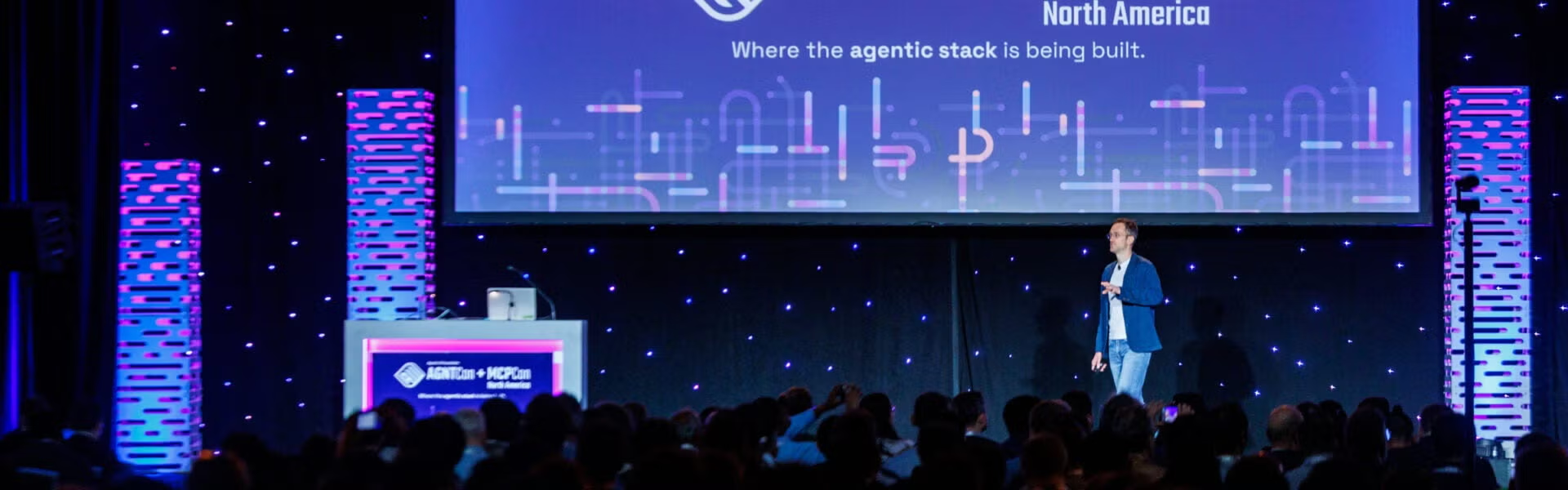
Overview
The event brings together the developers, researchers, platform builders, and enterprises advancing the next generation of AI agents—from core agent architectures and infrastructure to the protocols and tools that make agent systems interoperable.
Spanning the Model Context Protocol (MCP) and the broader agent landscape, AGNTCon + MCPCon explores how teams are building reliable, scalable, and secure agent systems in production. Through deep technical sessions, real-world case studies, and ecosystem collaboration, the conference provides a forum for sharing learnings, surfacing common challenges, and advancing open approaches to agentic AI.
Please be aware that the Linux Foundation will now be utilizing Sessionize for CFP submissions. Sessionize is a cloud-based event content management software designed to be intuitive and user-friendly. If you need guidance, please review how to submit your session for an event to see step-by-step instructions and helpful screenshots.
dates to remember
- CFP Closes: Monday, January 18 at 11:59 PM PST (UTC -07:00)
- CFP Notifications: Monday, February 15
- Schedule Announcement: Thursday, February 18
- Event Dates: Wednesday, April 28 – Thursday, April 29, 2027
Suggested Topics
- Agentic Engineering – Building and operating agents beyond the prototype. Share implementation details and tradeoffs in agent harnesses, multi-agent coordination, interoperability, deployment, infrastructure at scale, local and self-hosted inference, cost optimization, post-training, and self-improving agents. Topics also include context engineering, persistent memory, retrieval, knowledge graphs, tool discovery, and agentic search, with practical techniques for selecting, structuring, updating, and retrieving information. Sessions should offer lessons attendees can apply to their own systems.
- Enterprise Adoption in Practice – Implementing and scaling agents across an organization. Topics include choosing use cases, moving from pilots to production, integrating agents into existing workflows, establishing ownership and governance, supporting adoption across teams, and measuring business outcomes. Share concrete case studies, technical and organizational decisions, tradeoffs, and evidence of what worked or failed, including lessons from regulated environments.
- Evals & Reliability – Evaluating agent performance and maintaining reliability as systems change. Topics include evaluation pipelines, regression testing, software verification, observability, debugging, production incidents, and failure recovery. Share methods, results, and lessons that help teams detect problems, understand failures, and improve reliability.
- Security, Identity & Control – Securing agents and defining and enforcing what they are allowed to do. Topics include authentication, authorization, identity, delegation, sandboxing, guardrails, and human approval. Share threat models, implementation patterns, and lessons from securing agents, their tools, and the systems they access.
- Agent Interfaces & Interaction – Designing and implementing interactions between people, applications, and agents. Topics include agent-ready applications, browser and voice agents, generative interfaces, computer use, and human-agent collaboration. Share implementation techniques and design lessons that help people guide agents, understand their actions, and intervene when needed.
- Agentic AI 101 – Introductory sessions explaining the foundations of agentic AI and helping newcomers get started. Topics should explain when to use an agent, how models, tools, context, and memory work together, and/or how to build, evaluate, and safely run a first agent. Sessions should welcome newcomers, explain terminology, and use concrete examples without assuming prior experience building agents.
- Project: MCP – Implementing MCP clients and servers, including interactive experiences with MCP Apps, long-running work with Tasks, and capability distribution through Skills over MCP. We also welcome sessions on server discovery with Server Cards and securing deployments through authentication, authorization, OAuth Client Credentials, and Enterprise-Managed Authorization. Share architecture, demonstrations, or implementation lessons that help attendees adopt these capabilities in their own systems.
- Project: Skills – Authoring, distributing, and integrating Agent Skills, including SKILL.md files, supporting resources, skill discovery and loading, and evaluation for quality and safety. Proposals should share practical techniques, adoption experiences, or contributor insights.
- Project: AGENTS.md – Writing, organizing, and maintaining AGENTS.md instructions for coding agents. Topics include documenting setup, testing, coding conventions, and repository structure, organizing instructions across a monorepo, and keeping them useful as projects evolve. Proposals should center on creating, maintaining, or supporting AGENTS.md and share examples, evaluation results, or lessons from adoption.
- Project: goose – Building workflows with goose, extending it with MCP tools and skills, sharing recipes, using different model providers, or embedding goose in applications. Proposals should share practical techniques, implementation experiences, or insights into its architecture and development.
- Project: agentgateway – Deploying and extending agentgateway to route, secure, and observe traffic to models, MCP tools, and other agents. Topics may cover architecture, policy configuration, performance findings, or operational lessons.
- Project: Agent Router – Deploying and extending Agent Router, the Envoy-based project formerly known as Envoy AI Gateway. Topics include routing across providers, controlling access and usage, handling failover, and tracking performance and cost. Proposals should center on deploying, integrating, or extending Agent Router and share implementation experiences or contributor insights.
- Project: A2A – Implementing the Agent2Agent (A2A) protocol for collaboration between agents built with different frameworks. Topics include agent discovery, task delegation, streaming and asynchronous work, and secure communication across organizational boundaries. Proposals should center on implementing, deploying, or extending A2A and share interoperability lessons, protocol design decisions, or contributor insights.
- Project: Open Responses – Implementing or adopting the Open Responses specification across model providers, clients, and gateways. Topics include its shared request and response format, streaming events, tool interactions, and support for agent workflows. Proposals should center on Open Responses and share compatibility testing, integration lessons, or contributions to the specification and tooling.
- Project: OpenEnv – Creating and using OpenEnv environments for agent training and evaluation, including task and reward design, training framework integrations, and reproducible experiments. Proposals should share environment designs, experimental results, or implementation lessons.
- Project: OpenSandbox – Deploying and extending OpenSandbox for agent workloads such as code execution, file operations, browser use, and tool interactions. Sessions may cover the controls and infrastructure needed to operate these environments. Proposals should share lessons on isolation, sandbox lifecycle management, or scaling workloads.
submission types
- Session Presentation (25 minutes in length; 2 speakers max) – A focused technical talk on a specific problem, approach, or implementation. Share concrete examples, tradeoffs, and lessons attendees can apply. Match the depth to the selected track and keep the scope achievable in 25 minutes.
- Panel Session Presentations (25 minutes in length; 4 speakers max, including moderator) – A moderated conversation that brings together distinct perspectives on a focused question or challenge. Proposals should identify the discussion topics, intended panelists, and moderator, and explain what attendees will learn from the exchange.
- Lightning Talks (5 minutes in length; 2 speakers max) – A concise talk built around one idea, technique, experiment, or lesson. Get to the example quickly and give attendees a clear takeaway they can use or explore further.
- Workshops (90 minutes in length) – A guided, hands-on session in which participants build, test, or practice throughout. Proposals should describe the exercises, prerequisites, environment setup, and what participants will complete or take away. Plan for setup, troubleshooting, and participant support within the 90 minutes, with accessible materials attendees can revisit afterward.
- Live Demos (5 minutes in length; 2 speakers max) – A short demonstration of working technology. Show an agent, tool, or integration completing a concrete task, explain how it works, and highlight what attendees can learn from it. Center the session on the live demonstration.
- Poster Presentations (25 minutes in length; 2 presenters max) – An interactive poster presentation scheduled within the event program. Use a visual display to explain a project, research finding, architecture, or implementation, and be available to discuss it with attendees. Proposals should describe the work and the questions or lessons it invites.
important notes
- All speakers are required to adhere to our Code of Conduct. We also highly recommend that speakers take our online Inclusive Speaker Orientation Course.
- Each submitter may submit up to three sessions. Please focus on your strongest ideas—the findings you’re most excited to share. This limit helps our review committee give each proposal thoughtful consideration.
- Panels ( or any talk with more than two speakers) must include the names of all participants in the initial submission to be considered. In addition, The Linux Foundation does not accept submissions with all-male panels in an effort to increase speaker diversity.
- Complimentary Passes For Speakers – One complimentary SPEAKER pass for the event will be provided for the accepted speaker(s) per submission, 2 ATTENDEE passes will also be provided for the accepted speaker to invite guests.
- Avoid sales or marketing pitches and discussing unlicensed or potentially closed-source technologies when preparing your proposal; these talks are almost always rejected due to the fact that they take away from the integrity of our events, and are rarely well-received by conference attendees.
- Reviewers must be able to confidently assess a speaker’s subject-matter expertise from the proposal. Submissions that rely heavily on AI generated or templated content often lack the specificity needed to evaluate technical depth and may be harder to advance. Please ensure your proposal clearly reflects your own experience and understanding of the topic you intend to present.
- All accepted speakers are required to submit their slides prior to the event.
preparing to submit your proposal
While it is not our intention to provide you with strict instructions on how to prepare your proposal, we hope you will take a moment to review the following guidelines that we have put together to help you prepare the best submission possible. To get started, here are three things that you should consider before submitting your proposal:
- What are you hoping to get from your presentation?
- What do you expect the audience to gain from your presentation?
- How will your presentation help better the ecosystem?
There are plenty of ways to give a presentation about projects and technologies without focusing on company-specific efforts. Remember the things to consider that we mentioned above when writing your proposal and think of ways to make it interesting for attendees while still letting you share your experiences, educate the community about an issue, or generate interest in a project.
First Time Submitting? Don’t Feel Intimidated
Linux Foundation events are an excellent way to get to know the community and share your ideas and the work that you are doing and we strongly encourage first-time speakers to submit talks for our events. In the instance that you aren’t sure about your abstract, reach out to us and we will be more than happy to work with you on your proposal.
How to submit
First time using Sessionize?
Sessionize is a cloud-based event content management software designed to be intuitive and user-friendly. If you need guidance, please review how to submit your session for an event to see step-by-step instructions and helpful screenshots.
Submitting on behalf of somebody else?
While speakers ordinarily submit their sessions themselves, it’s also common for them to have someone else do it in their name. Submitters can choose to submit as someone else and must fill out the necessary speaker fields, but the session submission process is otherwise identical to when the session is submitted by the speaker themselves.
code of conduct
The Linux Foundation is dedicated to providing a harassment-free experience for participants at all of our events. We encourage all submitters to review our complete Code of Conduct.



